Is a toll road / E-ZPass text a scam?
Short answer: yes. A text claiming you have an unpaid toll and must pay immediately to avoid fees, late penalties, or legal action is one of the most-reported scams in the country right now. Toll authorities do not text payment links, and the real deadline pressure in these messages exists only to stop you from checking.
What does a toll-road (E-ZPass) scam text look like?
A text arrives claiming to be from a toll agency (E-ZPass, SunPass, FasTrak, or a similarly named regional tolling authority), saying you have an outstanding toll balance, often a specific-looking amount like “$69.99.” It warns that unless you pay by a certain date, you will face a late fee, a suspended license, or referral to a collections agency or the DMV. A link is included to “pay now.”
The link opens a page that looks like a real toll authority's site, complete with a logo and a payment form asking for your card number, expiration date, and billing zip code.
See an example
This is illustrative, not a subscriber submission: we ran a message written to match this scam's real-world pattern through our current system, and these are real excerpts from that check, cropped to the parts that matter, not the full text. For a real reply we actually sent, under our earlier format, switch to the other tab.
Subject: Fwd: TXTag DMV violation
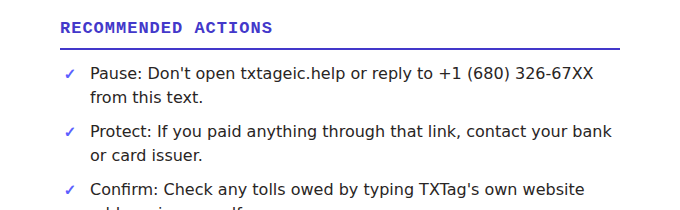
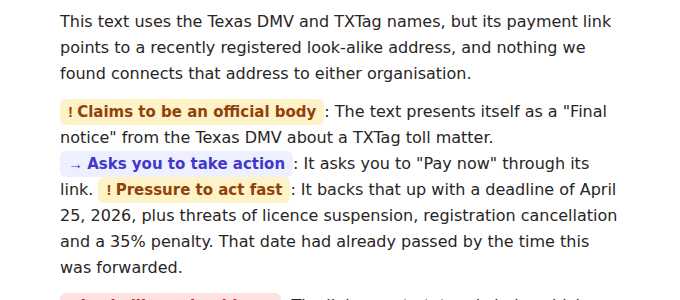
This is the reply we actually sent, quoted as it went out. It was assessed under our earlier verdict format, so it opens with a verdict word. Reports now open with the recommended actions and name what we found beneath them, with no verdict word. We never rewrite an assessment we have already delivered.
Verdict: SCAM
A user received a text claiming an unpaid toll of a few dollars, with a warning that a late fee and license suspension would follow if not paid within a day. The message included a link to a page styled like a real toll agency's site, asking for card details.
The link's domain did not match the toll agency's actual website, and the small, oddly specific dollar amount combined with the license-suspension threat is a textbook version of this scam. Real toll agencies bill through mailed statements or your own account login, never through a text link demanding same-day card payment.
Why does the toll-road text scam work?
Millions of people genuinely use toll roads and E-ZPass-style accounts, so the premise is plausible to almost anyone who drives. The dollar amount is kept small and specific, a real-looking toll rather than an obviously fake huge sum, so it feels more like a bill than a scam. The threat of a suspended license or debt collection creates urgency that pushes people to pay on their phone, on the spot, without logging into their actual toll account to check.
By the numbers: the FTC's own tally of 2024 text-message scams lists “bogus unpaid toll notices” as one of the top reported categories inside the $470 million people reported losing to text scams that year, more than five times the 2020 total. Source: FTC Data Spotlight, "Top text scams of 2024".
Red flags to watch for
- A text message (not a mailed bill or an alert inside your toll account's own app) about an unpaid toll.
- A link with a URL that does not match your toll agency's real domain, often a lookalike like “ezdrivema.com-invoice.info” or a random string ending in “.info,” “.top,” or “.xyz.”
- A short, specific-sounding deadline (“pay within 24 hours”) paired with a threat of a late fee, license suspension, or the DMV.
- A request for your full card number and billing details on a page reached only by tapping a text link.
- The message is unsigned or signed with a generic name, not your actual toll account's customer service name.
What should I do if I get a toll-road text?
- Do not tap the link. Do not enter any payment information on the page it opens.
- Delete the text, or report it as junk in your phone's messaging app.
- If you want to check for a real balance, go directly to your toll agency's official website or app, the same way you always log in, never through a link from the text.
- If you already entered card details, call your card issuer immediately (the number on the back of your card) to report possible fraud and get a replacement card.
- Not sure? Screenshot the text and send it in for a second opinion before you tap anything.
Got a toll text you are not sure about? Start a free trial and send us a screenshot. Our AI checks the message and emails you back what to do about it, and what it found.
Start your free trialVerify through official channels
- Report unwanted texts to the US Federal Trade Commission at reportfraud.ftc.gov.
- Report the message to the FBI Internet Crime Complaint Center at ic3.gov. Toll-text phishing has been the subject of public alerts from the FBI and multiple state toll authorities.
- Forward spam texts to 7726 (SPAM) to alert your mobile carrier.
- Check your actual toll balance only by logging into your toll agency's official app or website directly, not through a text link.