Is that Texas Parks & Wildlife text or email a scam?
Short answer: it can be either. Pause, then ask: send it to us, or check with TPWD through a route you found yourself.
Texas Parks and Wildlife sells and renews hunting and fishing licenses online through txfgsales.com, the sales site its own website names, and in person at about 1,700 locations. Real TPWD messages do reach people, and so do fakes wearing the department’s name. Three messages that presented themselves as coming from TPWD were sent to us to check: two texts and an email.
Does Texas Parks & Wildlife ever text or email you?
Yes. Our earlier guide said the department does not call or text about license renewals. That came from one phone call to TPWD, and we reported what the representative told us. It held for the text that guide covered. Since then we have checked two messages that break it: a real email from the sales site TPWD names, and a real text linking to tpwd.texas.gov.
TPWD’s own licensing page says, in these words: “Purchase official Texas hunting & fishing licenses, tags, permits and stamps on the Texas License Connection sales website txfgsales.com.” That is the only online sales site the page names. The other way to buy is in person, at about 1,700 retail locations plus TPWD offices and state parks. TPWD also collects a phone number when you buy a license (its licensing FAQ confirms this), and that FAQ says nothing either way about texting you.
So a message with TPWD’s name on it may be real, or not. The name settles nothing. Going to the source does.
How we helped
The renewal email: our reply
Subject: Texas Parks Wildlife License Renewal (#5754c2de)
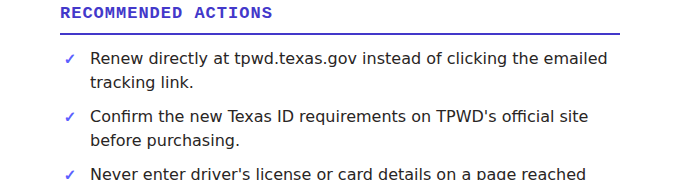
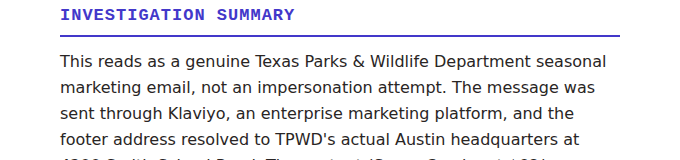
The Big Time Texas Hunts text: our reply, verbatim
Subject: Big Time Texas Hunts Text (#1a05851c)
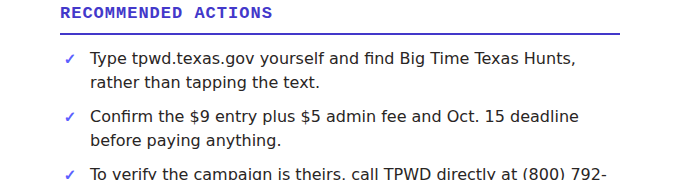
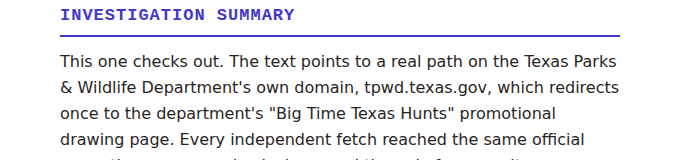
The short-link text. This is the text our earlier guide is built on, and that page quotes our full reply. It also used the department’s name and urged its recipient to grab a Texas Super Combo license today. Its link went through kvy1.io, an anonymous short link with no connection to any state domain, and it offered an 888 number that is not the number on TPWD’s licensing page. When we checked, the short link returned a 404 error, page not found, so we could not see where it was meant to lead. Nothing in the message pointed back to TPWD. We told the person who sent it not to tap.
When a link looks dead
Scammers control what a link does, and when.
- Scammers can switch a link on later. A page that did not load when you looked can be live the next time anyone looks. Some scam pages also show something harmless to anything that looks like a security check and keep the real trap for a visitor they judge to be a genuine target.
- Our own check shows what a human visitor would see. It takes a safe look at the page a link opens, so a link that shows nothing to a quick check can still be worth sending to us.
Why is “they would never contact me” the wrong test?
Because it is a guess about how a sender generally behaves, and fails in both directions. We made the first mistake ourselves: we turned one phone call into a rule, and a real email and a real text have both broken it since. The other direction is just as easy. A scammer can borrow a name, a logo, a headquarters address, even a real link placed next to a fake one, so “it looks official” is not a pass either.
The rule that held up across all three messages is simpler: go to the source. Start from something you already know is TPWD’s, its website typed in yourself, tpwd.texas.gov, or the number printed on its own licensing page, (800) 792-1112, and check from there whether the renewal, offer, or campaign is real. A shortened link, or an address that is not TPWD’s, is reason enough to stop right there. An address that looks right is not reason to relax, because a convincing fake can look right too. Only the source clears it. If that is more than you want to work through on your phone, pause and send it to us instead, and let our AI do the checking.
Our AI can be wrong too, so each assessment we send opens with steps you can check for yourself.
Why do fake TPWD texts work?
Because they sit next to real ones. A fake borrows a state agency’s name and attaches it to a real, recurring task, timed to land when it hits hardest.
- Hunting season opens in the fall, right when Texas licenses come up for renewal, so it is already on people’s minds.
- It plays on plain uncertainty: did I already renew? Or the opposite worry: why am I getting this if I already renewed?
- TPWD requires a phone number to buy or renew a license, so a text landing on a real customer’s phone is not surprising on its own.
- Real TPWD marketing exists, by email from its sales site and by text linking to its own site, so a fake has real ones to hide among.
- A shortened link hides where it goes, which is exactly what a fake needs.
By the numbers: people reported losing about $920 million to government impersonators in 2025, up from $866 million the year before. The FTC counts government impersonation among the fastest-growing scam categories it tracks. Source: FTC, “FTC Data Show People Reported Losing $3.5 Billion to Imposter Scams in 2025”.
Is this connected to the 2026 Texas Parks & Wildlife data breach?
Nothing public ties them together, and both are real. In 2026, TPWD disclosed a data breach at its license-system vendor that exposed phone numbers and other personal information for more than three million customers. No one, TPWD included, has connected that breach to the texts using the department’s name. Keep both in mind: real contact details were exposed, and real-looking texts are arriving.
Red flags to watch for
- A link that is not on tpwd.texas.gov or txfgsales.com, and any shortened link at all. If you cannot see where it goes, that is the flag.
- Pressure to renew or buy “today.”
- A phone number that is not one TPWD itself publishes. Its licensing page gives (800) 792-1112 and (512) 389-4800.
- A message that wants you to pay or sign in from inside it.
What the real ones had in common. None of this clears a message on its own, because a convincing fake can copy all of it:
- Links on tpwd.texas.gov or txfgsales.com, the addresses TPWD itself names.
- TPWD’s headquarters address, 4200 Smith School Road, Austin, in the footer.
What did settle it: everything each real message offered could also be reached from the source, by typing tpwd.texas.gov and finding the page from there. If you cannot get to the same offer that way, the message does not get the benefit of the doubt.
What should I do if I get a TPWD text or email?
- Pause. Do not tap the link, call the number, or pay from inside the message. Pausing costs nothing.
- Ask. Send it to us and let our AI do the checking. This is the simplest safe step, and it works whether the message turns out to be real or fake.
- Or go to the source yourself, through a route you found on your own. Type tpwd.texas.gov into your browser, or call TPWD at (800) 792-1112, the number on its own licensing page, and ask whether the renewal, offer, or campaign is real. For the Big Time Texas Hunts text, that call was the step we recommended: ask whether the campaign is theirs.
- Treat the address as a warning sign only. A link that is not on tpwd.texas.gov or txfgsales.com, any shortened link, or a phone number TPWD does not publish means stop right there. An address that looks right proves nothing, because a convincing fake can look right too, and in an email the words you see can hide a different address anyway. A matching address never replaces steps 2 and 3.
- Need to renew? Start at tpwd.texas.gov, typed in yourself. Its licensing page sends you to TPWD’s online sales site, txfgsales.com, or you can buy in person through an authorized retailer. If a message’s link really does go there, you lose nothing by typing the address instead. TPWD’s official Texas Hunt & Fish app can connect and display a license you already hold; it is not a place to buy one.
- Unwanted text from a sender you have not confirmed? Use your phone’s “Stop or Report Spam” option on the thread. Do not reply, not even STOP. A reply tells the sender your number is live.
Got a text or email you are not sure about? Start a free trial and send us a screenshot. Our AI checks the message and emails you back what to do about it, and what it found.
Start your free trial